← Previous Lesson (Geometric Symmetries) Next Lesson (The Fractals in Nature, Art, & Technology) →
He made us watch another video about Tessellations and patterns and all that. How.. cinematic? This time by Cristobal Vila.
What Makes a Polygon
A polygon is a 2D plane, enclosed, and made of perfectly straight lines which connect to each other at points labelled ‘vertexes’. A polygon has a minimum of three sides.
There are two types:
| Type | Definition | Example |
|---|---|---|
| Regular Polygons | All sides and angles are equal | Squares and equilateral triangles, or hexagons with the same side lengths and angle measures. |
| Irregular Polygons | Sides and angles can differ in measure | An obtuse triangle, which has differing angles and side measures. |
Tessellations and Tilings
A tesselation is a pattern created by covering a surface with shapes that fit together perfectly without any gaps or overlaps. Think of it like tiling a floor where each tile fits snugly next to its neighbors.
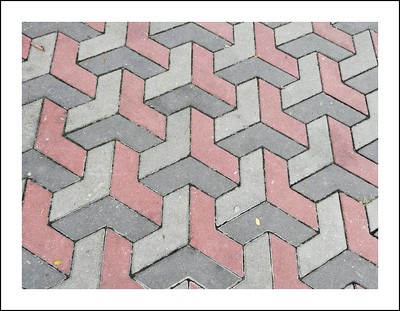
The word comes from the Latin tesella meaning small square tile. Some great examples:
- Honeycomb
- Brick Walls
- Bathroom Floors
- Scales
For a tessellation to work, the shapes must meet specific mathematical criteria. The angles must add up to exactly 360 degrees to ensure a perfect fit.
- No gaps between shapes
- No overlapping pieces
- Pattern extends infinitely in all directions
- Shapes can be regular or irregular polygons
There are also a few types of Tessellations.
| Type | Definition |
|---|---|
| Regular | Use only one type of regular polygon such as squares, triangles, or hexagons |
| Semi-regular | Combine two or more types of regular polygons while maintaining vertex uniformity |
How to Create Tessellations
- Choose a Base Shape
Start with any polygon. Triangle, square, hexagon, or an irregular shape if able.
- Apply Transformations
Use translation, rotation, reflection, or glide reflect to create copies of the original shape.
- Check the Fit
Ensure that all shapes fit together perfectly without gaps or overlaps at every connection point.
The Escher-Type Tessellation
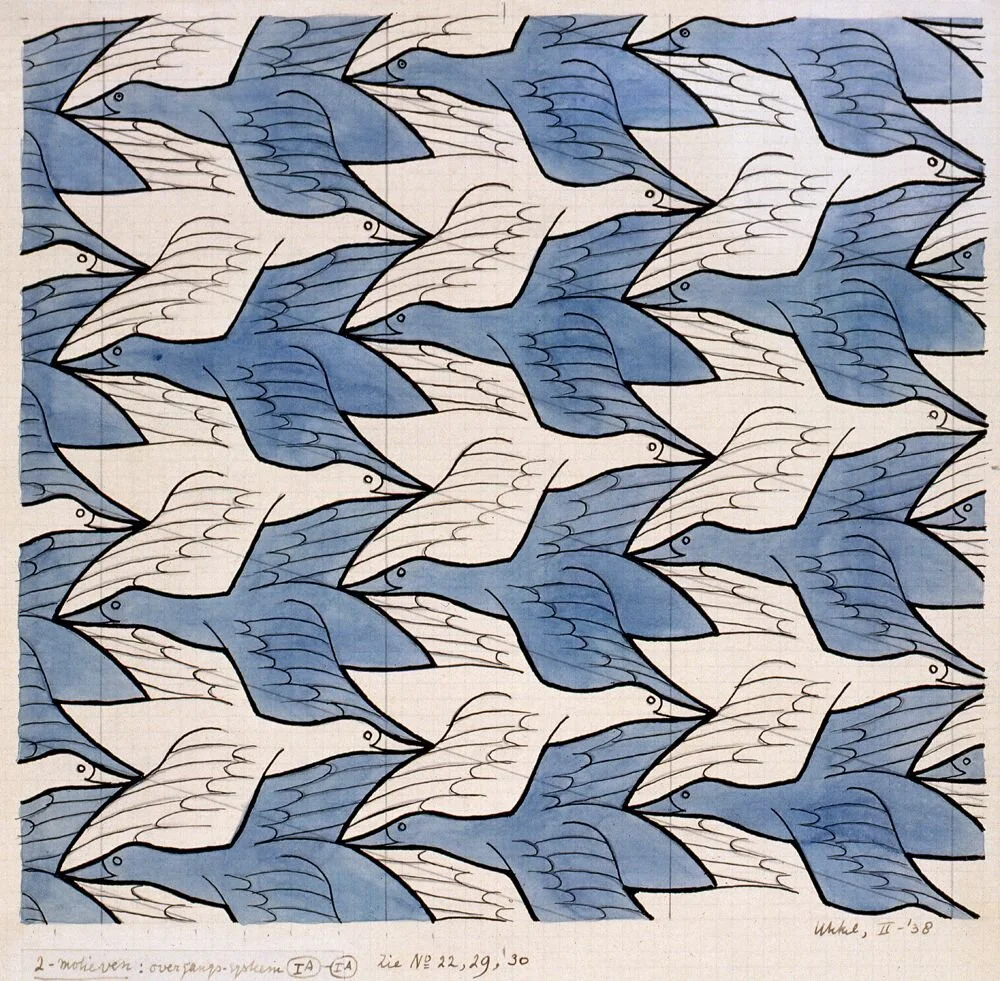
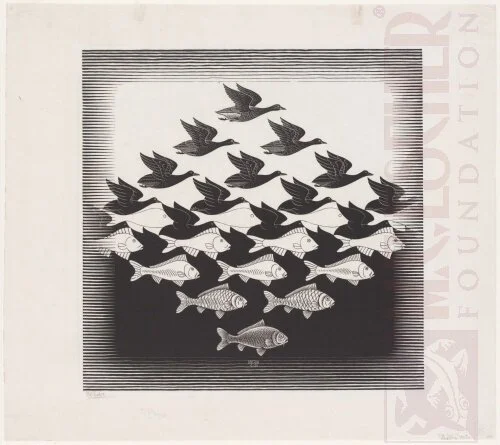
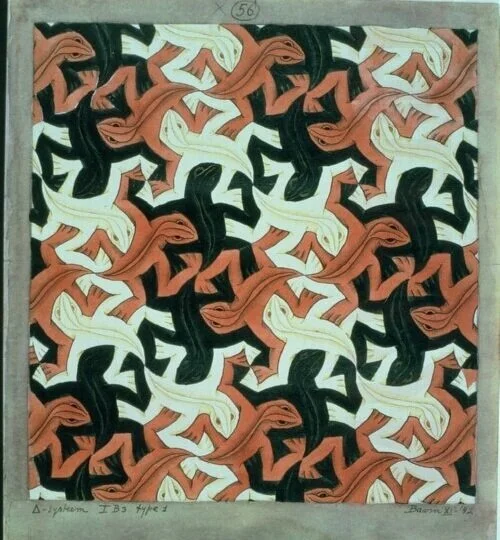
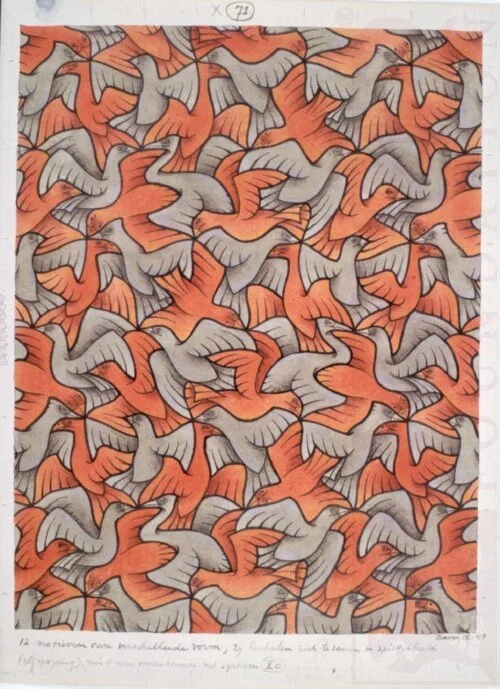
Maurits Cornelius Escher was a Dutch artist famous for his mathematically inspired artwork featuring impossible constructions and intricate tessellations. His patterns transform simple geometric to complex figures such as fish into proper artwork.
Search up Escher-Type Tesselation where he used birds, fish, people with newspapers, swans, and vague fish.
Frieze Patterns
This is defined as a wide, central horizontal band in architecture, typically located above eye level, which is often decorated with sculpture, carvings, or paintings.
It is a key element in classical design positioned between the architrave and cornice of an enteblature, though it can also refer to any decorative horizontal strip along a wall, like a color strip on the bottom of a wall or a wood panel along the wall.
I need a visualization.. what a headache :/ I'll link below where I got hte image from
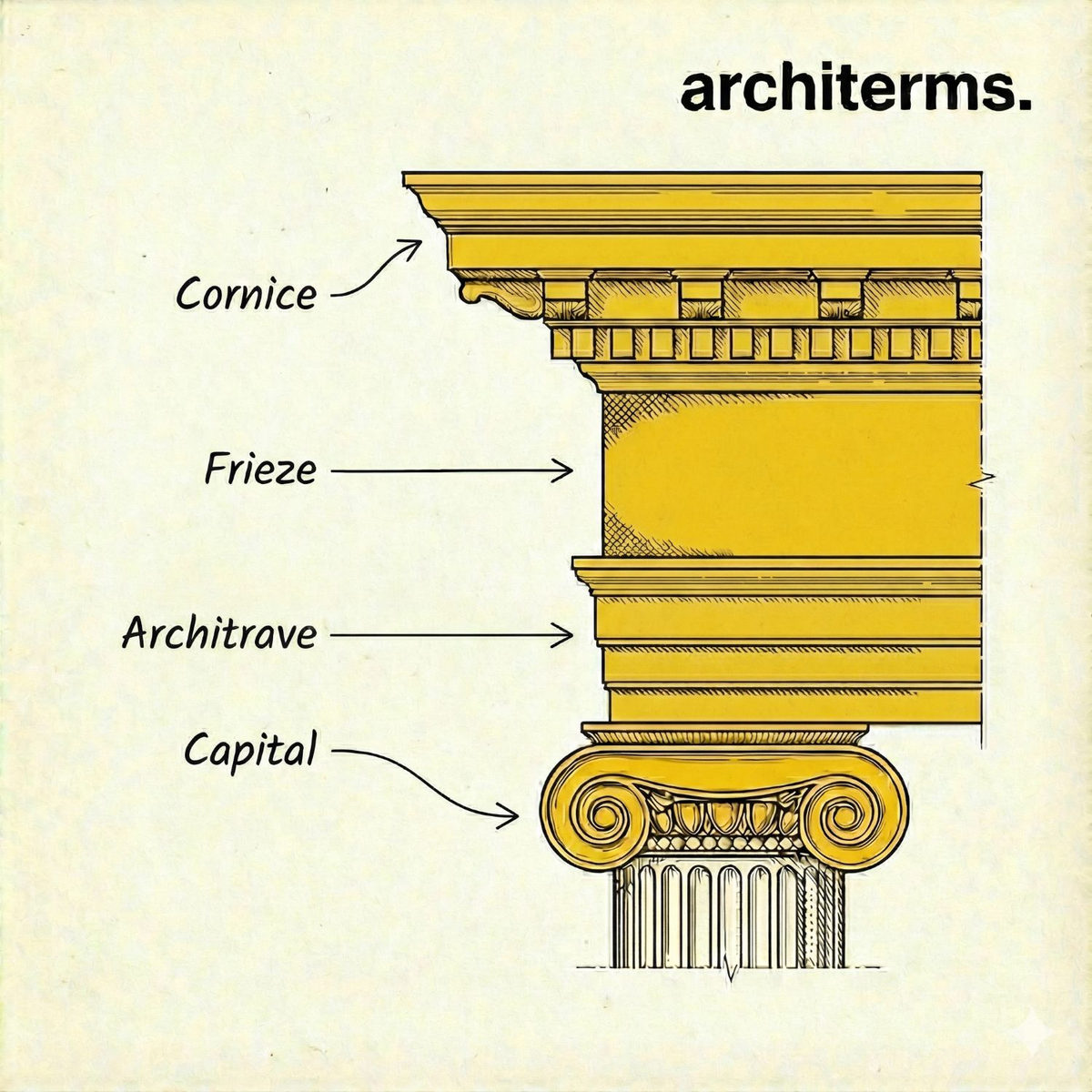
The architrave, frieze, and the cornice make up the enteblature. More on architecture in this link.
Context Use Classical Architecture It’s usually classical and holds some detailed sculptures of figures such as stated above Interior Decoration A painted or patterned band located just below a room’s ceiling or cornice. Like the wood or paint at the bottom of your walls Decorative Art A horizontal decorative panel on furniture, like on furniture or whatnot
The term comes from the 16th century French word frise which likely came from Medieval Latin frisium, which referenced embroidered cloth.
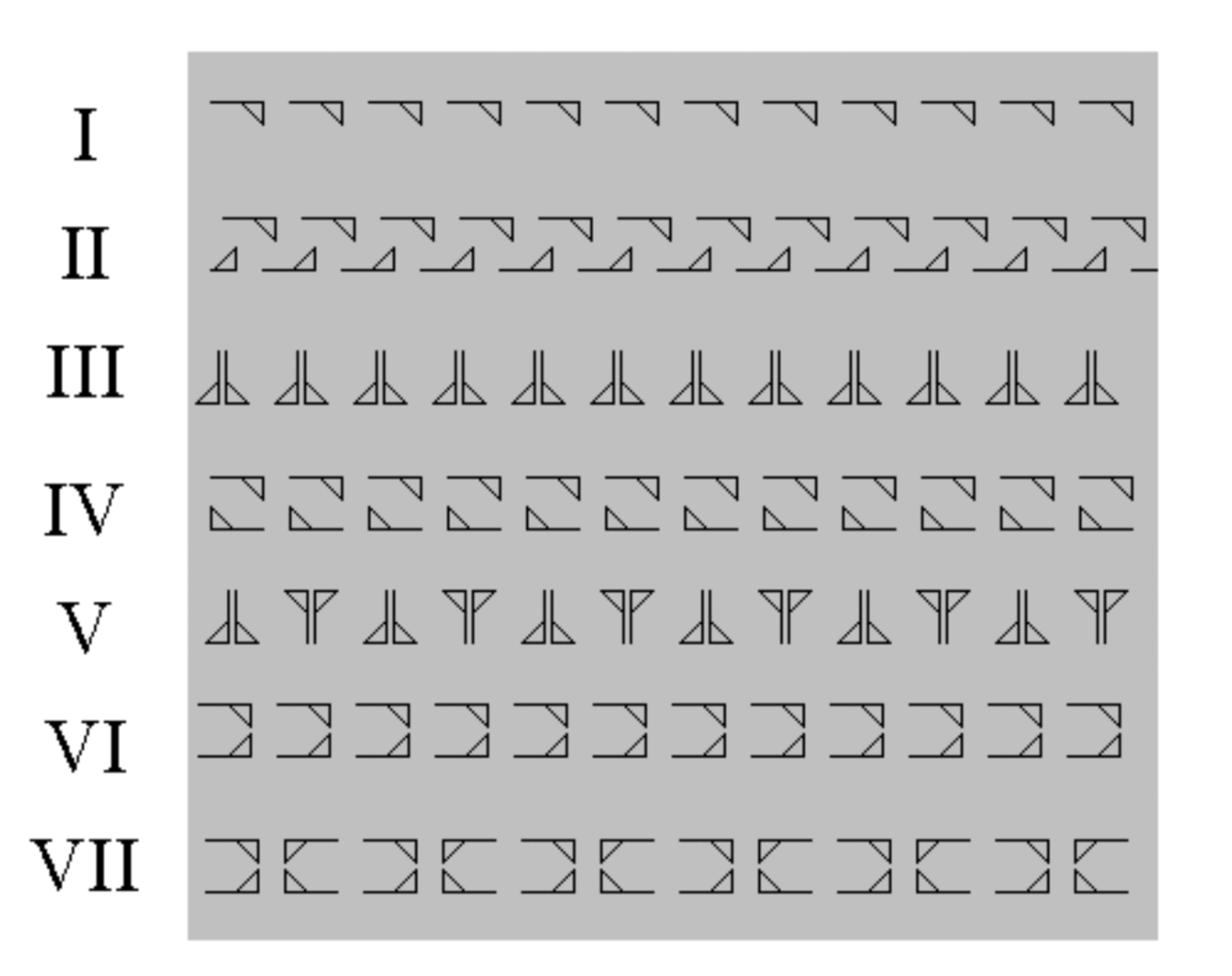
7 Frieze Patterns
Every one of these already have translation as a trait. This table represents unique traits.
Pattern (Translation) Glide Reflection 180 Deg. Rotation Vertical Reflection Horizontal Reflection Hop Step ✓ Spinning Hop ✓ Sidle ✓ Jump ✓ Spinning Sidle ✓ ✓ ✓ Spinning Jump ✓ ✓ ✓
You can review easier if you just look at the table above, ngl.
The 7 groups of Frieze Patterns are mathematically inclined concepts with their own notation (IUC Notation) employed in architecture, and you can find out more here. According to Conway's Naming Convention there are seven distinct types of these frieze patterns - repeating 2D patterns with translational symmetry. Also known as the following:
-
Hop
p1 (p111) Contains only translation (shifting).
-
Step
p11g (p1a1) Contains translational and glide reflection, but may not be perfectly symmetrical in the traditional sense.
-
Sidle [sic]
pm11 (p1m1) Contains translation and vertical reflection Patterns may be embedded above and under previous iterations of these patterns
-
Spinning Hop
p112 (p2) Contains translation and 180 degrees of rotations at least.
-
Spinning Sidle [sic]
p2mg (pmg2) Contains translation, vertical reflections, 180 degrees of rotation, and glide reflection.
-
Jump
p11m (p1m1) Contains translation and horizontal reflection.
-
Spinning Jump
p2mm (pmm2) Contains translation, horizontal reflections, 180 degrees of rotation, and glide reflection. This is the opposite of the spinning sidle, horizontal counterpart.
A clearer picture is labelled below for reference.
← Previous Lesson (Geometric Symmetries) Next Lesson (The Fractals in Nature, Art, & Technology) →