Distance & Displacement
Distance
This tells us the total path travelled by something. It is a Scalar quantity and only has magnitude. It is always positive, and the SI unit for this is a meter (m).
Distance can be calculated after adding all the movement together. Example 1: A student walks 5m to the east, then 3m east again. Find the distance.
The solution here is just to add the total movement: Distance = 8m.
Future note: The displacement here is equal to 10m east.
Displacement
This is the straight-line change in the position of an object, regardless of how much it truly moved. It refers to its change in position from the starting point to the ending point. It is a Vector quantity, with magnitude and direction, and is always a straight line.
It can be positive, negative, or zero, and is measured in meters (m). When referring to negative numbers, it is only a sign of direction — refer to a Cartesian plane and its quadrants for a similar idea.
Displacement can be found by adding (subtracting) the initial position from the final position. Example 2: A student walks 10m east and then 5m west. Find the distance & displacement.
Displacement: (10) + (-5) = 5
Distance is 15m, and displacement is 5m east.
Example 3: An athlete runs 9m east and 40m south. Find the distance and displacement.
Distance is 49m. For displacement, this forms a right triangle, so calculate the hypotenuse:
√(9² + 40²) = 41
41m South of East
I recommend having a calculator on hand when calculating displacement.
Note: the direction is not SE (southeast), since SE refers specifically to a 45° angle. Since the angle formed here isn’t close to 45°, it should be referred to as South of East instead. More on this in the Direction Using Angles section below.
Practice Example
“A rescue drone is dispatched from the Emergency Operating Centre (Station A) to deliver medical supplies to several evacuation stations after a typhoon. The drone follows the route below: A → B: 8km E B → C: 6km N C → D: 12km E D → E: 10km S E → F: 9km W F → G: 4km N At Station G, the drone stops and transmits its final position. What is the total distance travelled by the drone? Determine the drone’s displacement from Station A to G and in what general direction the drone is located relative to Station A.”
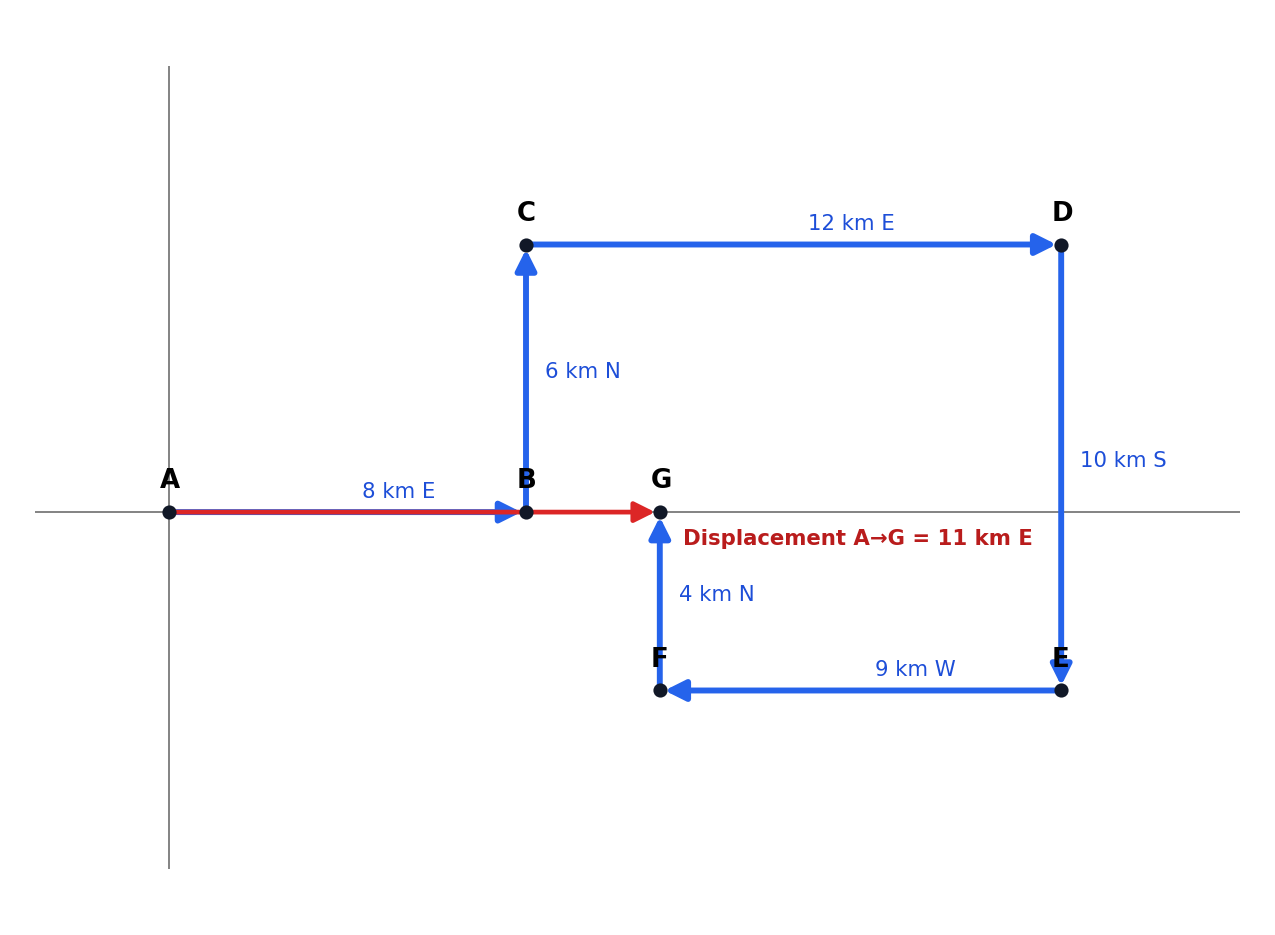
You can calculate the distance from B to G by subtracting segment FE from segment CD, since they’re parallel — this gives 3km. Adding the initial 8km, the displacement of the drone from A to G is 11km due East. It’s due East because A and G sit on the same horizontal line (parallel to segment CD/FE). If you want to prove this theoretically, analyze segments CB and GF and relate them to segment DE.
The total distance is simply the sum of all the route segments:
Distance A → G = 49km
Displacement A → G = 11km East
Scalar vs Vector
Scalars
This value asks “How much?” of something there is. It refers only to magnitude.
- Distance
- Speed
- Mass
- Time
- Temperature
Vectors
This value also asks how much there is, but adds “Which way?”. It asks for magnitude and direction of a particular force or object. Vectors are represented by a letter with an arrow above it (→).
- Displacement
- Velocity
- Force
- Acceleration
- Momentum
Anatomy of a Vector
A vector looks largely like a ray, with a few more details attached to it.
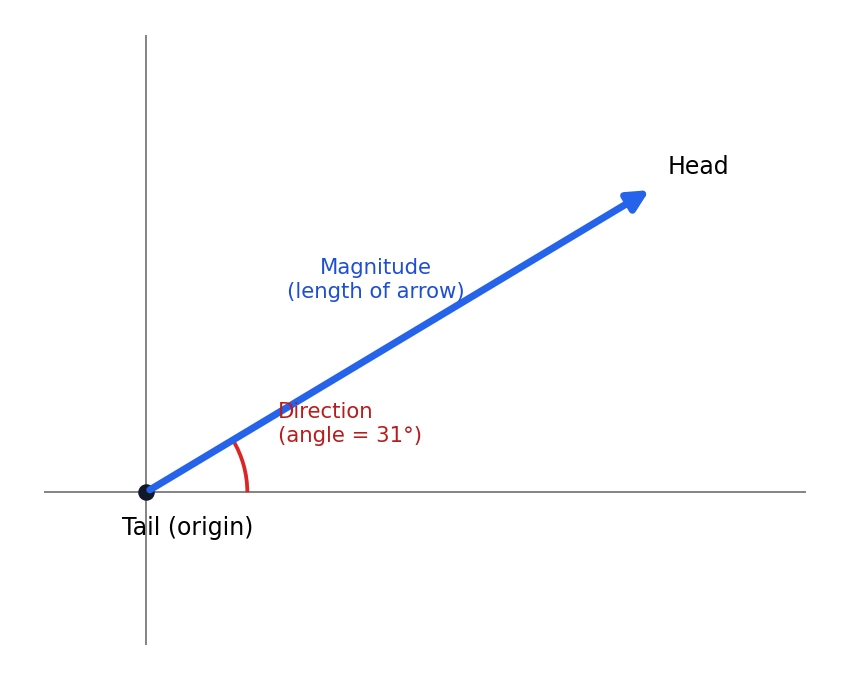
- Direction: the precise angle the vector is moving toward
- Magnitude: the length / amount of force behind the vector
- Tail: the origin point of the vector
- Angle: angle relative to the x-axis
A vector contains a number, a direction, and (usually) an SI unit.
The Direction Using Angles
A common way of identifying direction is by reference to the four Cardinal directions.
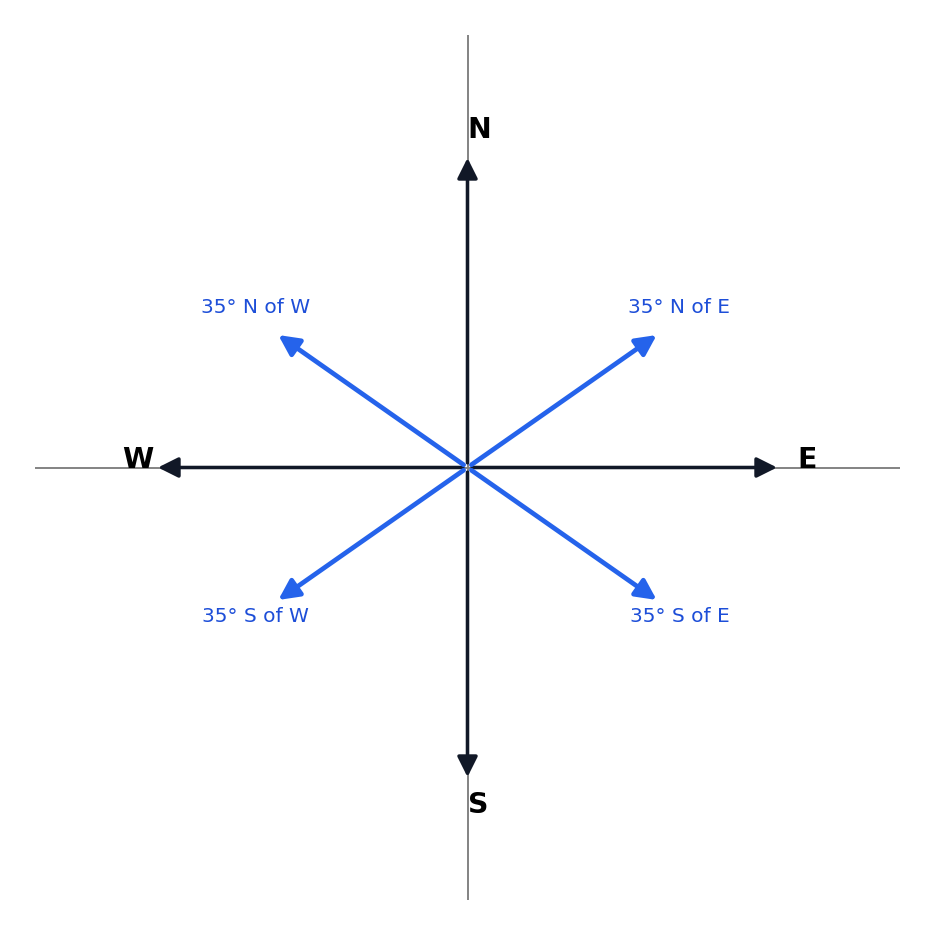
The angle is always measured starting from the horizontal axis (East or West) it’s closest to, then pivoted toward the vertical axis (North or South) — e.g. “35° North of East” or “35° South of West”.
Vector Addition
A resultant is the vector sum of more than one vector — combining vectors of different magnitudes and directions into one.
There are three rules:
- Same direction: Add the magnitudes of the vectors, and use their shared direction.
- Opposite directions: Subtract the magnitudes of the two vectors, and follow the direction of the larger magnitude.
- Right angle to each other: Use the Pythagorean theorem to find the magnitude of the resultant (the hypotenuse). For direction, use SOH-CAH-TOA (or CHO-SAH-CAO).
Example 1 — Same Direction
“Ana and Lia are walking in the hallway towards east. Ana has a velocity of 25m/s while Lia is 15m/s. Calculate the resultant vector.”
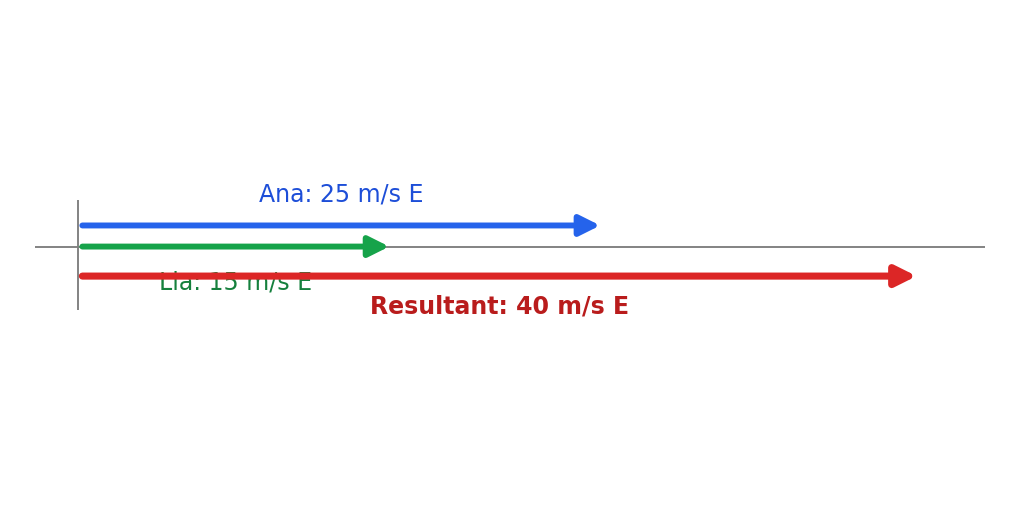
This falls under Rule 1 — just add the magnitudes:
25 + 15 = 40 m/s, East
Example 2 — Opposite Directions
“From the classroom, Mark walks 8 meters west towards the library and Angel from the library walks 15 meters east to the computer lab. Find the resultant vector.”
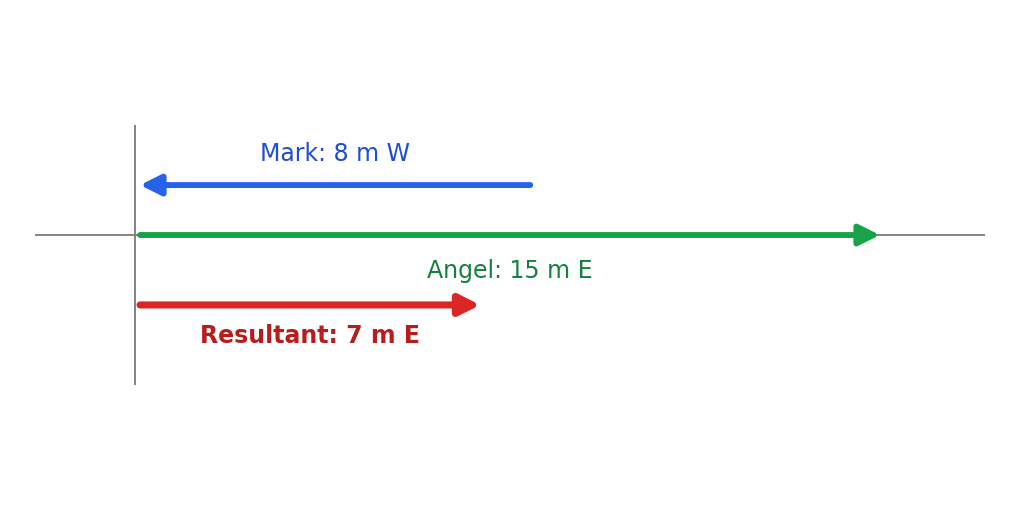
Use the larger vector’s direction (East), then subtract:
15 - 8 = 7m, East
Example 3 — Right Angle
“A car travels 4km east, then turns south for another 3km. Find the magnitude and direction of the resultant.”
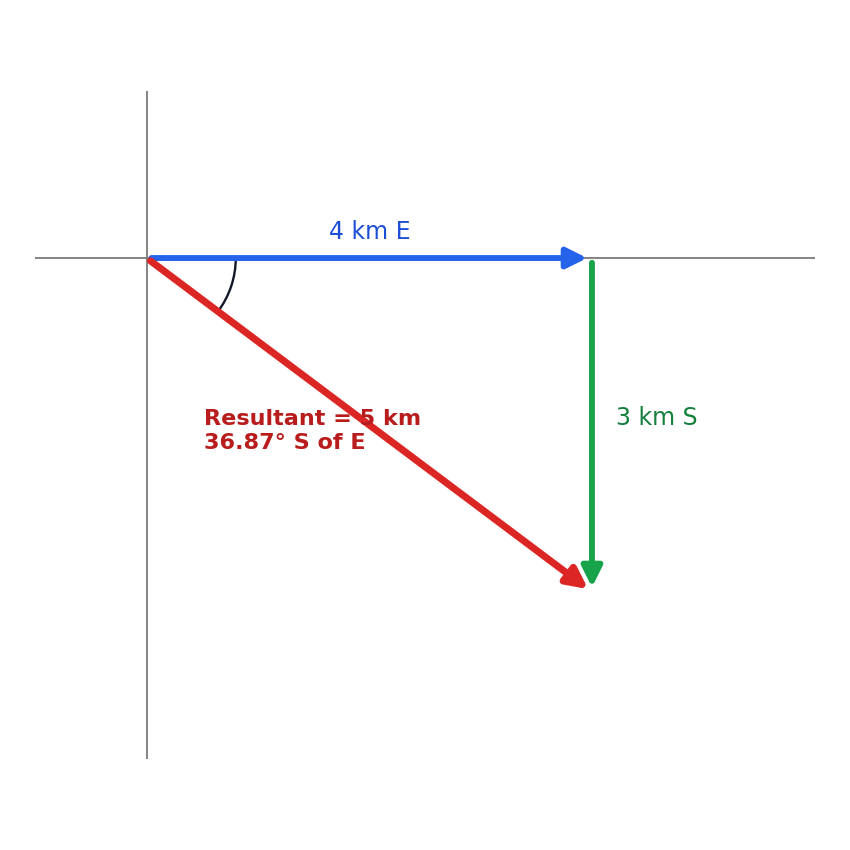
The direction is South of East, based on where it originated. First, find the magnitude with c = √(a² + b²):
c = √(4² + 3²) = 5
Then find the angle with tan(θ) = opposite/adjacent:
θ = tan⁻¹(3/4) = 36.87°
Resultant = 5km, 36.87° South of East.
Example 4 — Right Angle (solving for a leg)
“A woman walks East along a street for 50m and then turns North until the magnitude of her displacement from the starting point is 75m. How far does she walk as she goes North, and what is her direction from her original position?”
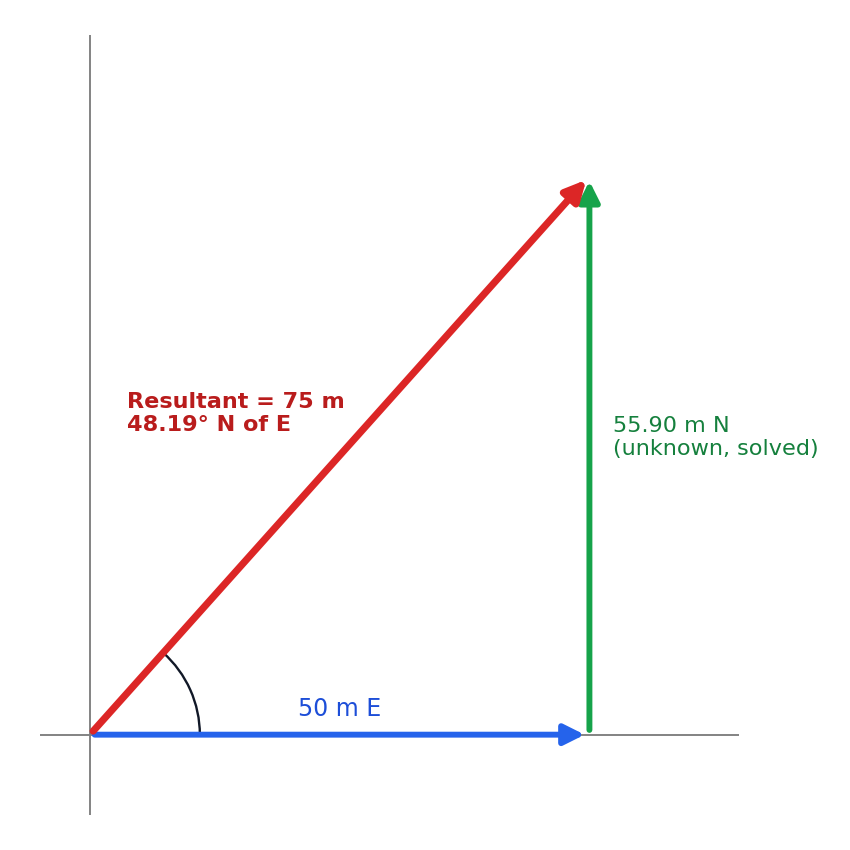
Use the Pythagorean theorem to solve for the North leg: b = √(c² - a²)
b = √(75² - 50²) ≈ 55.90m, North
Then solve for the angle:
θ = tan⁻¹(55.9/50) ≈ 48.19°
Since the angle is measured from the East axis going up toward North, this is called North of East.
Example 5 — Multi-Leg Path
“An ant walks 8cm to the east, then 8cm to the south, then turns and walks 12cm to the west, and finally 18cm to the north. What’s the displacement of the ant?”
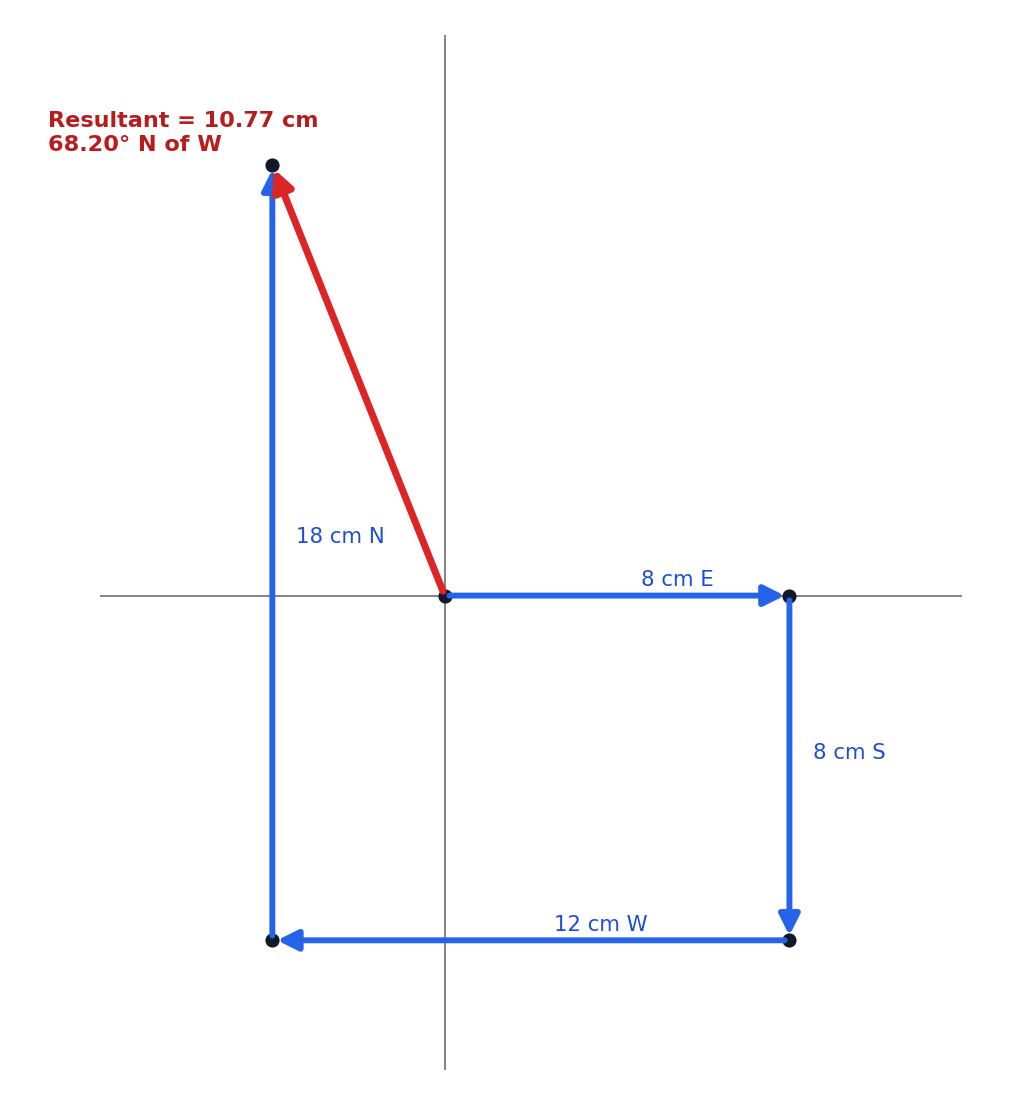
The right triangle involved in the ant’s displacement has legs of 10cm and 4cm, with θ positioned between the shorter leg and the hypotenuse.
c = √(4² + 10²) ≈ 10.77cm
θ = tan⁻¹(10/4) ≈ 68.20°
Since the angle is measured connected to the West axis heading toward North, the answer is 10.77cm, 68.20° North of West.
Vector Addition (Component Method)
The reference angle is always based off the horizontal axis — use complements or supplements to find it when needed.
There are five steps:
- Write the vector’s x-component (Vx = V cos θ) and y-component (Vy = V sin θ), where V is the magnitude.
- Apply the sign of each quadrant (+, +), (−, +), etc.
- Get the sum of the components, using the quadrant signs to guide you.
- Calculate the resultant magnitude with the Pythagorean theorem:
r = √((ΣVx)² + (ΣVy)²)- Get the direction of the resultant through θ and inverse tan.
The easiest way to do this is to tabulate it, using reference angles measured from the horizontal axis.
Example 1
“A = 40lbs, 52° W. B = 60lbs, 30° E. C = 50lbs, 70° E (southside). These are all reference angles.”
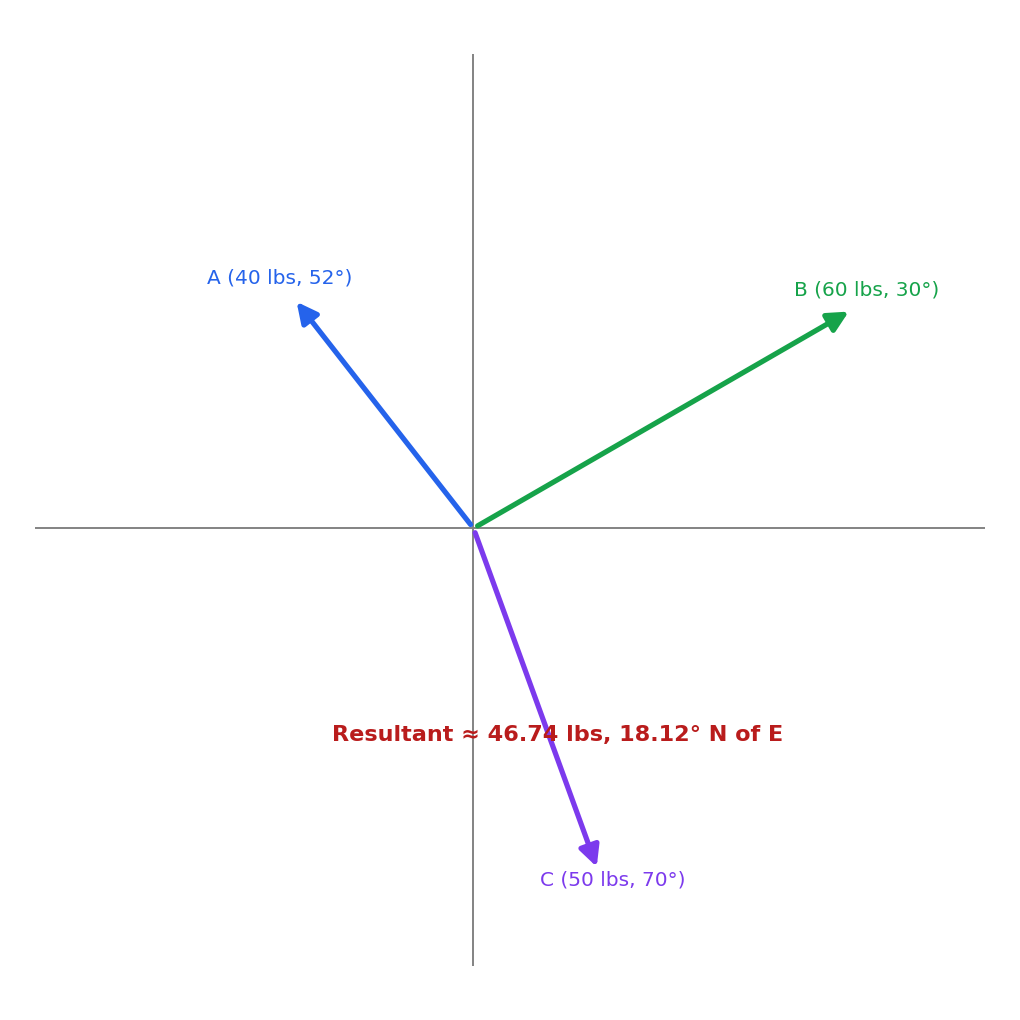
| x-component | y-component | |
|---|---|---|
| A | Vx = 40cos(52) = −24.63 (W) | Vy = 40sin(52) = +31.52 |
| B | Vx = 60cos(30) = +51.96 (E) | Vy = 60sin(30) = +30 |
| C | Vx = 50cos(70) = +17.10 (E) | Vy = 50sin(70) = −46.98 |
| Total | ΣVx = 44.43 E | ΣVy = 14.54 N |
Remember to designate direction based on the +/− signs of each quadrant.
r = √(44.43² + 14.54²) ≈ 46.74 lbs
θ = tan⁻¹(14.54/44.43) ≈ 18.12°
R = 46.74 lbs, 18.12° N of E.
Note: in the component method, direction is written as “N of E” rather than the full “North of East.”
Example 2
“Find the resultant vector using the component method: Vector A is 17 lbs at 35° above the x-axis, Vector B is 21 lbs at 45° clockwise from the negative y-axis, and Vector C is 35 lbs at southeast.”
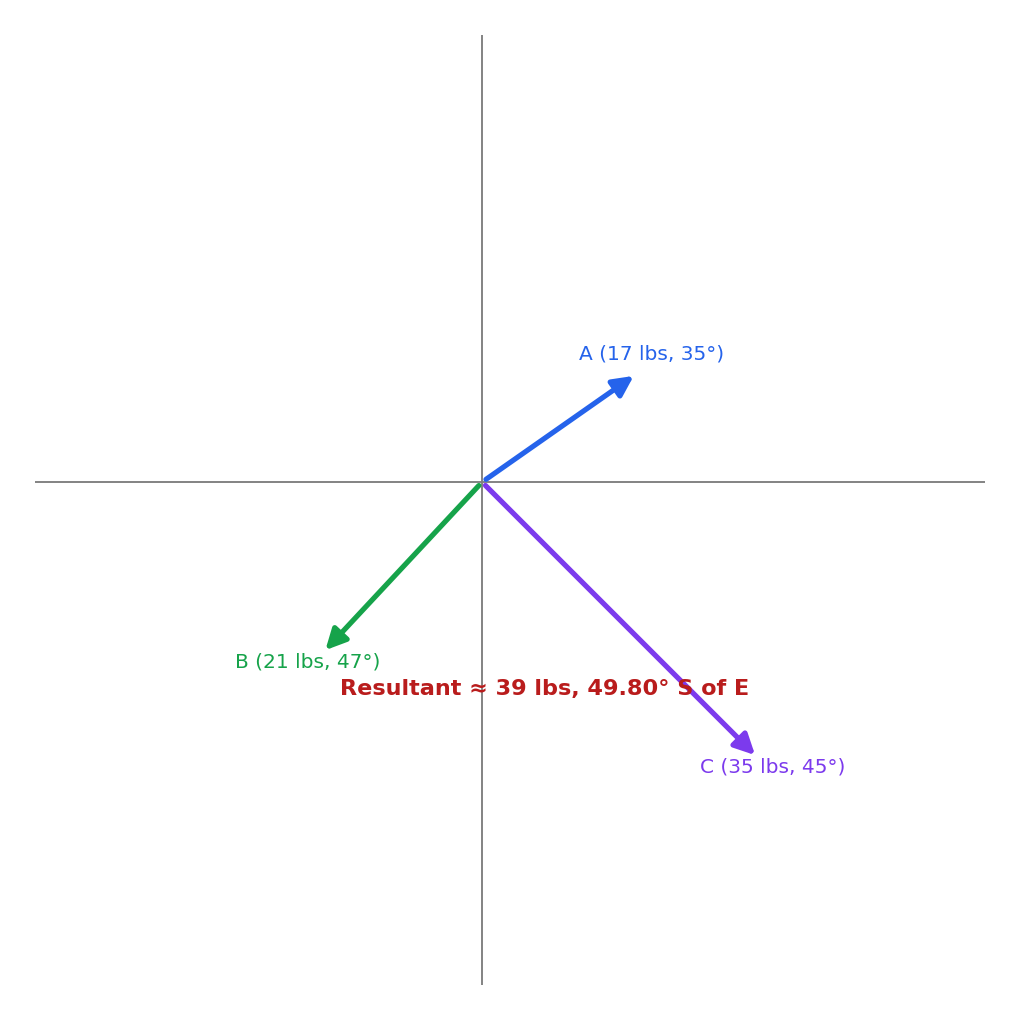
The reference angle for A is 35°, since it’s measured from the x-axis (assumed North of East here). Taking the complementary angle for B gives 47°. C is 45° Southeast.
| x-component | y-component | |
|---|---|---|
| A | Vx = 17cos(35) = +13.92 (E) | Vy = 17sin(35) = +9.75 |
| B | Vx = 21cos(47) = −14.32 (W) | Vy = 21sin(47) = −15.36 |
| C | Vx = 35cos(45) = +24.75 (E) | Vy = 35sin(45) = −24.75 |
| Total | ΣVx = 24.35 E | ΣVy = −30.36 S |
r = √(24.35² + 30.36²) ≈ 38.91 lbs
θ = tan⁻¹(30.36/24.35) ≈ 51.28° (disregard the negative sign)
R ≈ 39 lbs, ≈50° S of E.
Note: the original working used 18cos(35)/18sin(35) for vector A instead of the stated 17 lbs — recalculating with 17 lbs (shown above) gives a very slightly different total, but lands on essentially the same final answer (~39 lbs).
In Short
| Concept | Summary |
|---|---|
| Distance | Scalar; total path length; always positive |
| Displacement | Vector; straight-line change in position; can be +/−/0 |
| Scalars | Magnitude only (distance, speed, mass, time, temperature) |
| Vectors | Magnitude + direction (displacement, velocity, force, acceleration, momentum) |
| Vector Addition (Graphical) | Same direction → add; opposite → subtract; right angle → Pythagorean theorem |
| Vector Addition (Component) | Break into Vx/Vy → sum → recombine with Pythagorean theorem + inverse tan |