Next Lesson (Scalar & Vector) →
What is Physics?
Physics is the branch of science that studies how the universe behaves through observation, experimentation, and mathematical analysis.
The word comes from the Greek
Physis, meaningNature.
It focuses on five core areas:
Core Area Description Matter Anything with mass that occupies space (solids, liquids, gases, plasma) Energy The capacity to do work or cause change (kinetic, potential, thermal, etc.) Motion Change in an object’s position over time Forces Interactions that can change an object’s motion or shape Space & Time The framework in which objects exist and events occur
Why study Physics?
- Understand natural phenomena
- Develop technology
- Solve real-world problems
- Improve quality of life
- Explore the universe
Branches of Physics
Branch Focus Real-Life Applications Mechanics Motion and Forces Vehicles, sports, engineering Thermodynamics Heat and Energy Refrigerators, air conditioners, engines, power plants Optics Nature and propagation of light Telescopes, mirrors, lenses, space probes Quantum/Nuclear Physics Structure of atomic particles Nuclear plants, chemical laboratories, colliders, electricity Physical Chemistry Combines principles of Physics & Chemistry Car batteries, melting ice, pressure cookers, solar panels
Reflect: "What examples of physics can you observe in your daily life?" — try to list at least 3.
Types of Physical Quantities
To access all the list of physical quantities, press on this link.
These are defined as a Numerical Value & Unit
5m : 5 is the numerical value, m is the unit
Fundamental Quantities
Independent quantities from which others are derived from.
2 kilograms of rice, 50 meters
Derived Quantities
Obtained by combining fundamentals.
Speed = 45m/s Pressure = kg/m
SI Units
To access all the list of SI Units and prefixes, press on this link.
It’s the set of units that are recognized around the world.
Prefix Symbol Power of 10 kilo k 10³ hecto h 10² deka da 10¹ Base Unit — 10⁰ deci d 10⁻¹ centi c 10⁻² milli m 10⁻³
Understand that the International System of Units is labelled as SI UNITS. If you are wondering why specifically it’s named SI, and not IS, it is because the original term was French:
Systeme International D’Unites
In 1971, the 14th General Conference on Weights and Measures picked seven quantities as base quantities, forming the basis of SI — popularly known as the metric system.
Conversion of Units
To access all the normal conversions, press on this link.
System of Measurement
System Description British/English System Uses foot, pound, and seconds — defined in terms of SI Units Metric/SI System Uses standard units and prefixes that are multiples of 10
Steps to Change Units
- Select the conversion factor
- Make two ratios/fractions (from the conversion factor)
- Multiply the correct ratio to the given
- Cancel units (by checking numerator/denominator)
Worked Examples
Ex. 1: Convert 445 g to kg 445g · (1kg/1000g) = 0.445 kg
Ex. 2: Convert 15 m to yd (1m = 3.28ft, 1yd = 3ft) 15m · (3.28ft/1m) · (1yd/3ft) = 16.4 yd
Ex. 3: Convert 2 ft² to in² (1ft = 12in → 1ft² = 144in²) 2ft² · (144in²/1ft²) = 288 in²
Ex. 4: Convert 30 km/hr to m/s (30km/1hr) · (1000m/1km) · (1hr/3600s) = 8.33 m/s
Accuracy & Precision
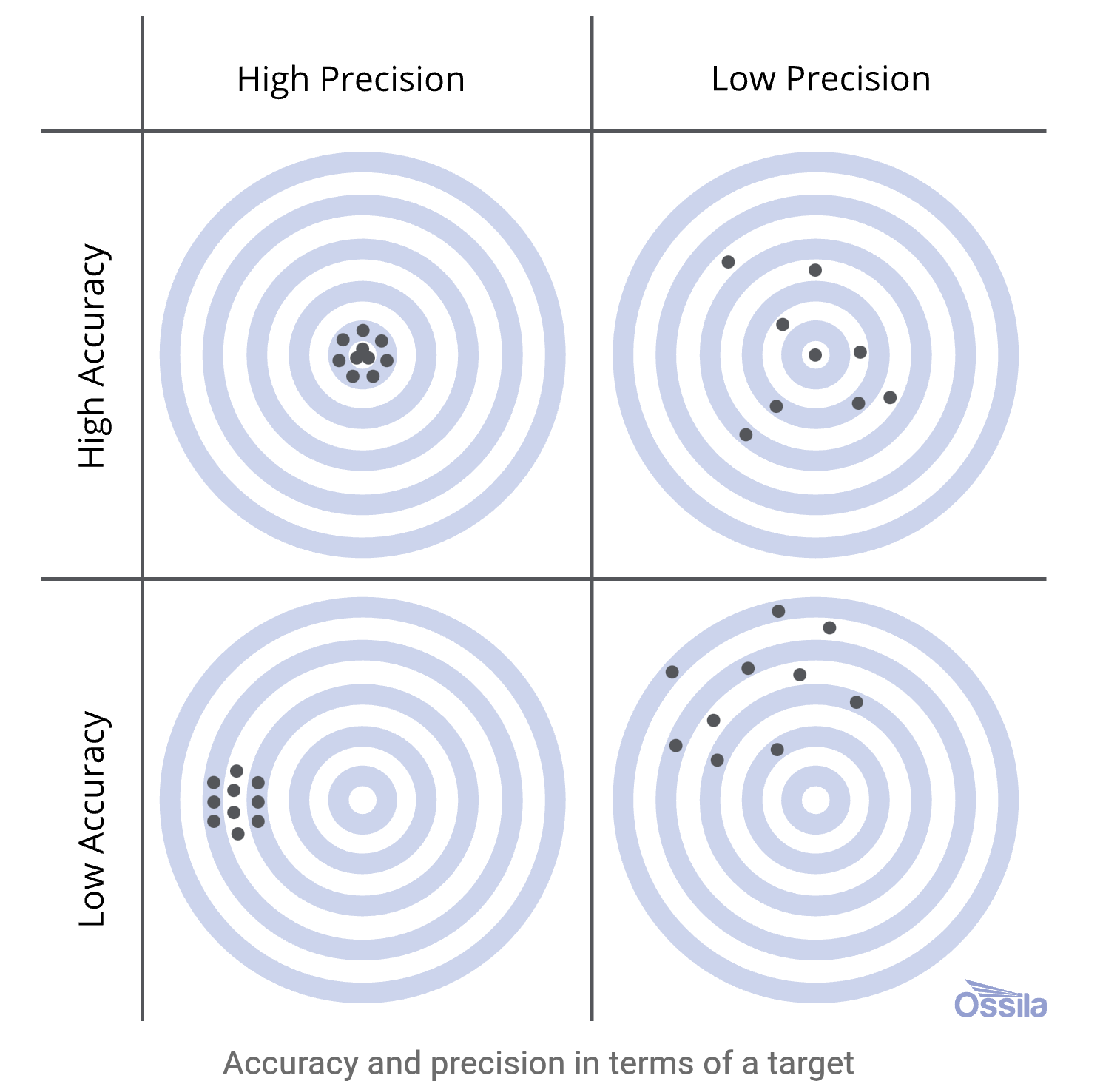
Accuracy is defined as closeness of a measurement to the accepted value.
Precision is the closeness of repeated measurements to each other.
Concept Example (Accepted = 100.0g) Explanation Accurate, not Precise 98.9, 100.2, 101.1, 99.8 Scattered, but average is close to accepted value Precise, not Accurate 95.2, 95.1, 95.3, 95.2 Close to each other, far from accepted value Accurate & Precise 99.9, 100.0, 100.1, 100.0 Close to each other AND to accepted value Neither 92.5, 105.8, 98.1, 110.3 Scattered and far from accepted value
Here’s a visual representation of it.
Scientific Notation
A method of expressing very large/small numbers compactly using powers of ten.
a × 10ⁿ
a= number ≥ 1 and < 10n= integer exponent (places the decimal point has moved)
Rules for Moving the Decimal
Direction Exponent Example Move left (large numbers) Positive (+) 48,000,000 → 4.8 × 10⁷ Move right (small numbers) Negative (−) 0.00045 → 4.5 × 10⁻⁴
Rules for Rounding Off
- Digit dropped < 5 → retain preceding digit, replace succeeding digits with 0
942,391 = 940,000 | 0.045439 = 0.04500
- Digit dropped ≥ 5 → add 1 to preceding digit, replace succeeding digits with 0
335,249 = 340,000 | 0.027615 = 0.02800
Significant Figures
Digits in a measurement that carry meaningful info about its precision — all certain digits + one estimated digit from the instrument used.
Rules for Determining Significant Figures
Rule Example Sig. Figs All nonzero digits are significant 25.6 / 482 / 7.123 3 / 3 / 4 Zeros between nonzero digits are significant 1,005 / 3.04 / 50.08 / 6.070 4 / 3 / 4 / 4 Leading zeros are not significant 0.0025 / 0.00078 / 0.0456 2 / 2 / 3 Trailing zeros in whole numbers without a decimal are not significant 1500 / 7000 2 / 1 Trailing zeros, including those before a decimal, in a number with a decimal are significant 60 / 60.0 1 / 3
To avoid ambiguity in trailing zeros, use scientific notation:
1.5 × 10³ → 2 SF | 1.50 × 10³ → 3 SF | 1.500 × 10³ → 4 SF
Note that the fifth rule is actually an unofficial rule that I wrote. That rule usually is embedded inside Rules 2 and 4 by default, I just separated it.
Steps for Rounding to Significant Figures
- Identify the desired number of significant figures
- Look at the digit immediately to the right
- If ≥ 5, round up
- If < 5, leave the preceding digit unchanged
Ex. 1: Round 8.7642 to 3 SF → next digit is 4 (< 5) → 8.76 Ex. 2: Round 9.995 to 3 SF → next digit is 5 (≥ 5) → carries over → 10.0 Note: written as 10.0 (not 10) to preserve 3 significant figures.
In Short
Field Summary Physical Quantities Numerical Value + Unit → Fundamental vs. Derived SI Units International System (metric); 7 base quantities SI Prefixes Multiples of 10, from quecto (10⁻³⁰) to quetta (10³⁰) Conversion of Units Select factor → form ratio → multiply → cancel units Accuracy & Precision Closeness to true value vs. closeness among repeated trials Scientific Notation a × 10ⁿ; simplifies very large/small numbers Significant Figures Indicates precision/reliability of a measurement