How Physics Fits Everyday Life
Household & Thermodynamics
- Curie Point : The critical temperature where a
ferromagneticmaterial undergoes a phase transition and loses its permanent magnetic properties. - Bernoulli’s Principle : Fan blades cause the air traveling on the curved side to move faster, creating a low pressure area and a stream of air.
Health & Safety
- Biomechanics : The study of human movement applied in injury prevention, performance enhancement in sports, rehab & therapy, and the design of devices (like prosthetics/airbags).
- Radiology : Diagnostic imaging & ergonomics.
- Work : Simple everyday machines — pulleys, motors, etc.
- Sports : Monitoring of body movement for sports performance.
Realms of Physics
Classical Physics
Foundational knowledge from before the 20th century — covers macro/observable phenomena that can be seen and measured.
Branch Focus Mechanics Forces (or their absence) and the resulting motion — e.g. orbits, gravity. Thermodynamics The flow of heat, temperature, and energy conversion. Acoustics Transmission, control, and generation of mechanical (sound) waves as they travel through different media. Optics Fundamental behaviors, nature, and properties of light, and related visual phenomena. Electromagnetism (EM) Forces acting on electric charges and magnetic fields — the spin of electrons and the generation of these forces.
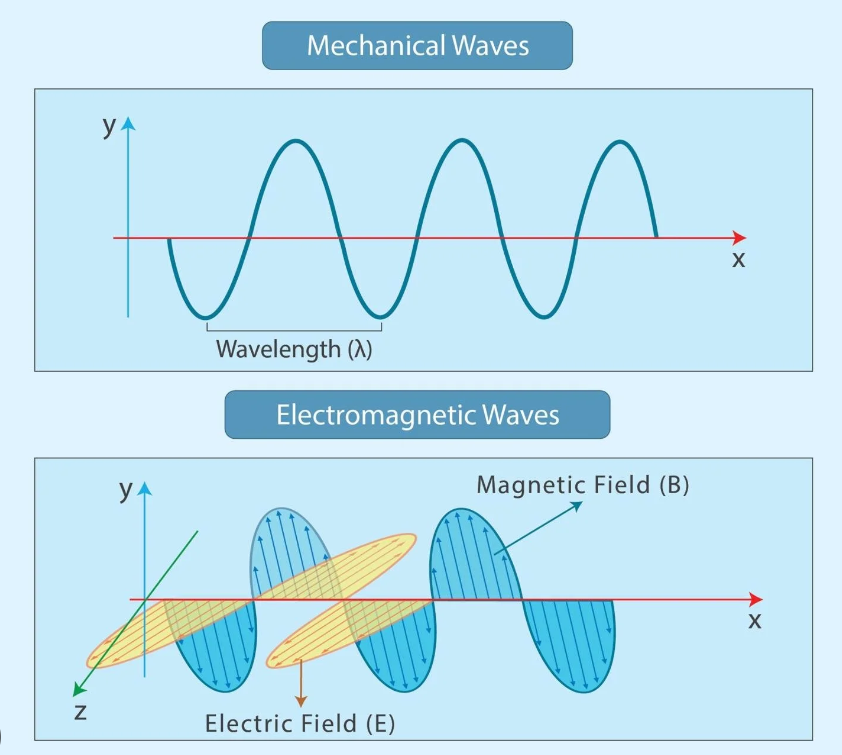
A quick comparison between mechanical waves and light (EM) waves:
Mechanical Waves Light (EM) Waves Speed Slower Faster Nature Carries sound/vibration Travels over long range Medium Requires a medium to travel through Needs no medium
Modern Physics
A revolutionary body of scientific knowledge from the 20th century to now, dealing with subatomic scales and things approaching the speed of light.
Branch Focus Atomic Physics Studies atoms, nuclei, and the properties of an atom’s electron shell. Nuclear Physics Focuses exclusively on the forces, radioactivity, and the reactions occurring inside the nucleus of an atom. Quantum Physics Explores matter & energy at an atomic and sub-atomic scale, where things commonly become unpredictable. Relativistic Physics Formulated by Einstein, deals especially with supremely high velocities, where nothing travels faster than light, and mass/energy behave differently.
Physicists and Their Major Contributions
-
Aristotle
384–322 BC Ancient Greek philosopher Explained all change (motion, growth, decay) and its causes (material, formal, efficient, final) — the world understood through the
earthvsaether(imperfect vs perfect worlds)
-
Galileo Galilei
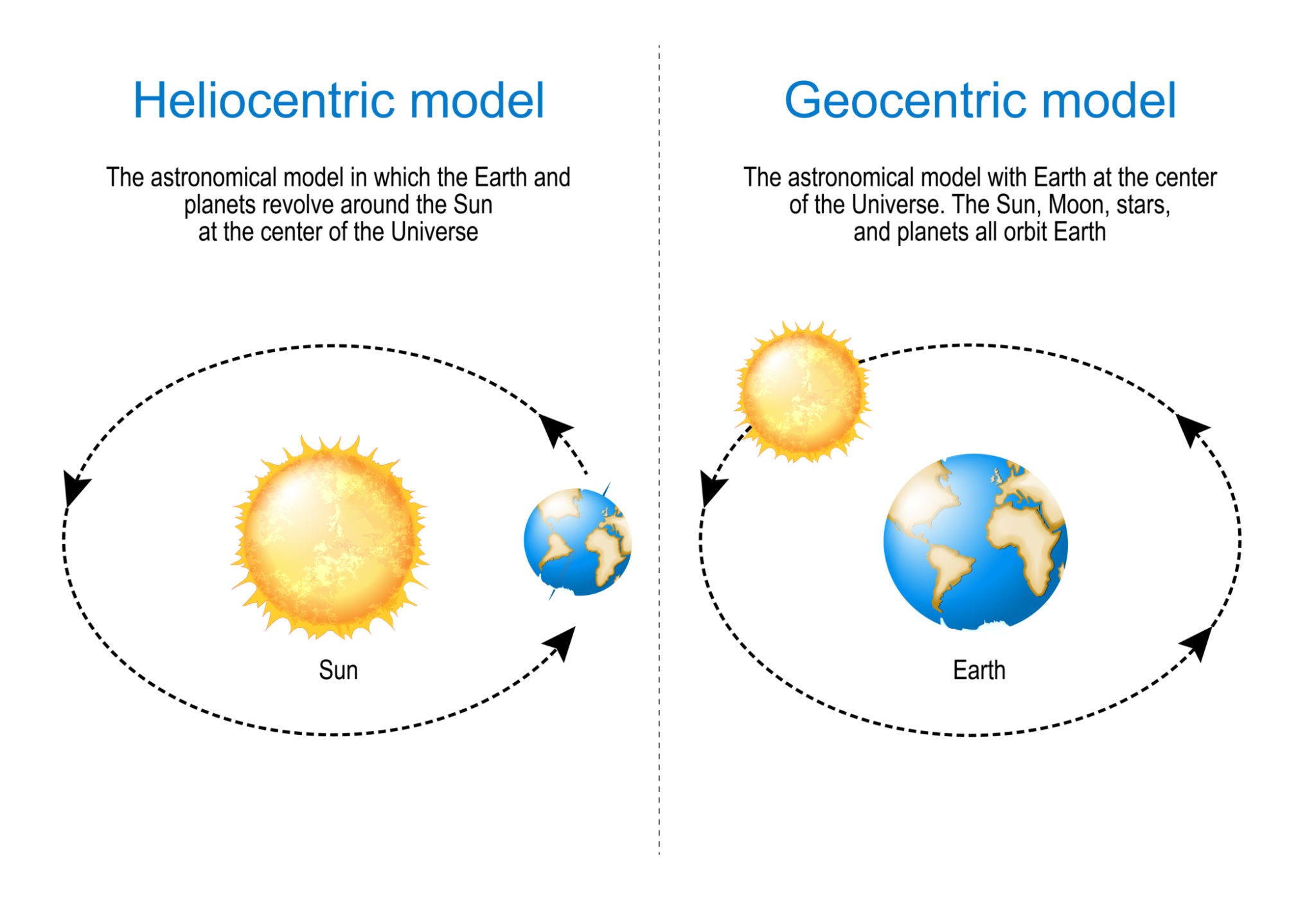
1564–1642 Italian astronomer and physicist Refined the telescope to discover Jupiter’s four largest moons, phases of Venus, and the rugged surface of the moon Proved the Earth orbits the Sun, not the Earth orbited by the sun (
heliocentrism)Inertia — bodies fall at the same rate regardless of mass
-
Isaac Newton
1643–1727 Father of classical physics, wrote the most influential laws of physics
-
Nikola Tesla
1856–1943 His design laid the groundwork for modern AC (
alternating current)
-
Marie Curie
1867–1934 Polish-French physicist and chemist Pioneered research on radioactivity (a term she coined) and died to it because of exposure First person to win Nobel Prizes in two different sciences (Physics, 1903; Chemistry, 1911)
The
Curie pointmentioned above is actually named after her husband, Pierre Curie, who discovered it while researching magnetism
-
James Clerk Maxwell
1831–1879 Scottish physicist Unified electricity, magnetism, and light into a single theory of electromagnetism Maxwell’s Equations became the foundation of classical electromagnetism and predicted the existence of electromagnetic waves
This lesson was..
Honestly a chore. Argh.